Some tools for collective epistemics
webAuthors
Credibility Rating
3/5
Good(3)Good quality. Reputable source with community review or editorial standards, but less rigorous than peer-reviewed venues.
Rating inherited from publication venue: EA Forum
An EA Forum post examining practical tools for improving group reasoning quality, relevant to AI safety research communities that need robust collective epistemic practices to navigate complex technical and strategic questions.
Forum Post Details
Karma
71
Comments
9
Forum
eaforum
Forum Tags
AI safetyAI governanceAnnouncements and updatesOrganization updatesTools for collaborative truth-seeking
Part of sequence: Design sketches for a more sensible world
Metadata
Importance: 42/100analysis
Summary
This EA Forum post surveys practical tools and methods for improving collective reasoning and belief formation in groups, addressing how communities can aggregate knowledge and reduce epistemic failures. It explores mechanisms that help groups arrive at more accurate beliefs and better decisions together.
Key Points
- •Surveys a range of tools designed to improve how groups reason, share information, and form collective beliefs
- •Addresses common failure modes in group epistemics such as groupthink, information cascades, and overconfidence
- •Discusses mechanisms like prediction markets, structured debate, red-teaming, and deliberative processes
- •Relevant to AI safety communities seeking to improve research culture and decision-making quality
- •Provides actionable recommendations for organizations and communities aiming to foster intellectual honesty
Cached Content Preview
HTTP 200Fetched Apr 7, 20263 KB
# Some tools for collective epistemics By Forethought, Owen Cotton-Barratt, Lizka, Oliver Sourbut Published: 2026-02-06 We’ve recently published a set of design sketches for AI tools that help with collective epistemics. We think that these tools could be a pretty big deal: * If it gets easier to track what’s trustworthy and what isn’t, we might end up in an equilibrium which rewards honesty * This could make the world saner in a bunch of ways, and in particular could give us a better shot at handling the transition to more advanced AI systems We’re excited for people to get started on building tech that gets us closer to that world. We’re hoping that our design sketches will make this area more concrete, and inspire people to get started. The (overly-)specific technologies we sketch out are: * [Community notes for everything](https://www.forethought.org/research/design-sketches-collective-epistemics#community-notes-for-everything) — Anywhere on the internet, content that may be misleading comes served with context that a large proportion of readers find helpful * [Rhetoric highlighting](https://www.forethought.org/research/design-sketches-collective-epistemics#rhetoric-highlighting) — Sentences which are persuasive-but-misleading, or which misrepresent cited work, are automatically flagged to readers or writers * [Reliability tracking](https://www.forethought.org/research/design-sketches-collective-epistemics#reliability-tracking) — Users can effortlessly discover the track record of statements on a given topic from a given actor; those with bad records come with health warnings * [Epistemic virtue evals](https://www.forethought.org/research/design-sketches-collective-epistemics#epistemic-virtue-evals) — Anyone who wants a state-of-the-art AI system they can trust uses one that’s been rigorously tested to avoid bias, sycophancy, and manipulation; by enabling “pedantic mode” its individual statements avoid being even ambiguously misleading or false * [Provenance tracing](https://www.forethought.org/research/design-sketches-collective-epistemics#provenance-tracing) — Anyone seeing data / claims can instantly bring up details of where they came from, how robust they are, etc. 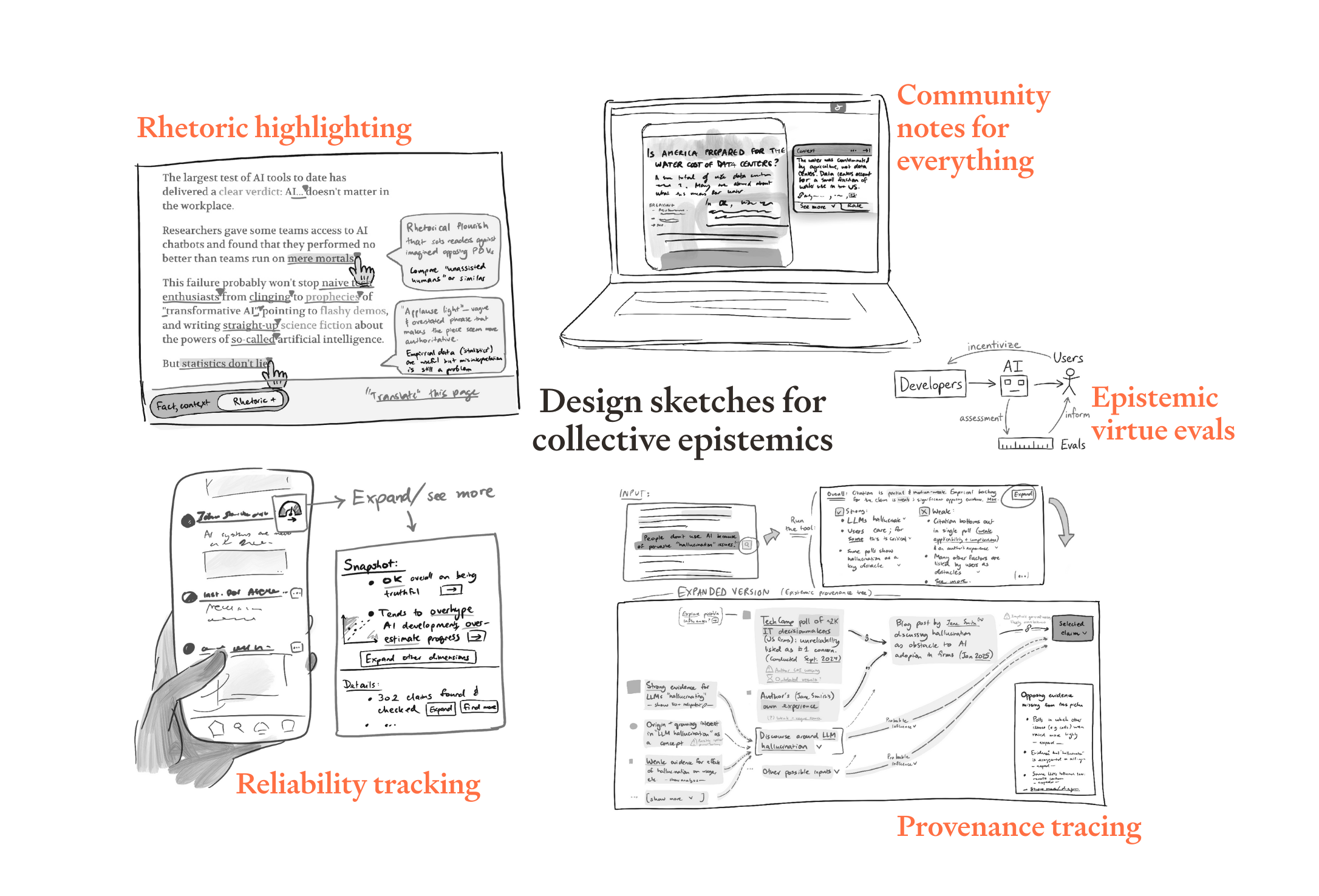 If you have ideas for how to implement these technologies, issues we may not have spotted, or visions for other tools in this space, we’d love to hear them. *This article was created by* [*Forethought*](https://www.forethought.org/about)*. Read the original* [*on our website*](https://www.forethought.org/research/design-sketches-collective-epistemics)*. *
Resource ID:
0294cc403f8cc2cb | Stable ID: sid_amfabv4YmO