Are the Costs of AI Agents Also Rising Exponentially?
webAuthor
Toby_Ord
Credibility Rating
3/5
Good(3)Good quality. Reputable source with community review or editorial standards, but less rigorous than peer-reviewed venues.
Rating inherited from publication venue: EA Forum
An EA Forum analysis exploring the economic scaling dynamics of AI agents, relevant to understanding deployment risks, access concentration, and safety oversight as agentic AI systems become more prevalent.
Forum Post Details
Karma
81
Comments
10
Forum
eaforum
Forum Tags
AI safetyForecastingAI benchmarksAI forecastingEconomics of artificial intelligence
Part of sequence: The Scaling Series
Metadata
Importance: 42/100analysis
Summary
This EA Forum post examines whether the computational and financial costs of deploying AI agents are scaling exponentially alongside their capabilities, drawing a parallel to the well-known exponential growth in AI training costs. The analysis considers implications for the accessibility, deployment patterns, and safety oversight of increasingly capable AI agent systems.
Key Points
- •Investigates whether inference and operational costs for AI agents are growing exponentially, mirroring trends in training compute costs.
- •Explores how rising agent costs could affect who can deploy advanced AI systems and what tasks become economically viable.
- •Considers implications for AI safety if only well-resourced actors can afford the most capable agent deployments.
- •Draws on trends in AI scaling to assess whether cost trajectories could limit or concentrate agentic AI capabilities.
- •Raises questions about how cost dynamics should inform governance and oversight frameworks for AI agents.
Cached Content Preview
HTTP 200Fetched Apr 7, 202614 KB
# Are the Costs of AI Agents Also Rising Exponentially?
By Toby_Ord
Published: 2026-02-02
There is an extremely important question about the near-future of AI that almost no-one is asking.
We’ve all seen the graphs from METR showing that the length of tasks AI agents can perform has been growing exponentially over the last 7 years. While GPT-2 could only do software engineering tasks that would take someone a few seconds, the latest models can (50% of the time) do tasks that would take a human a few hours.
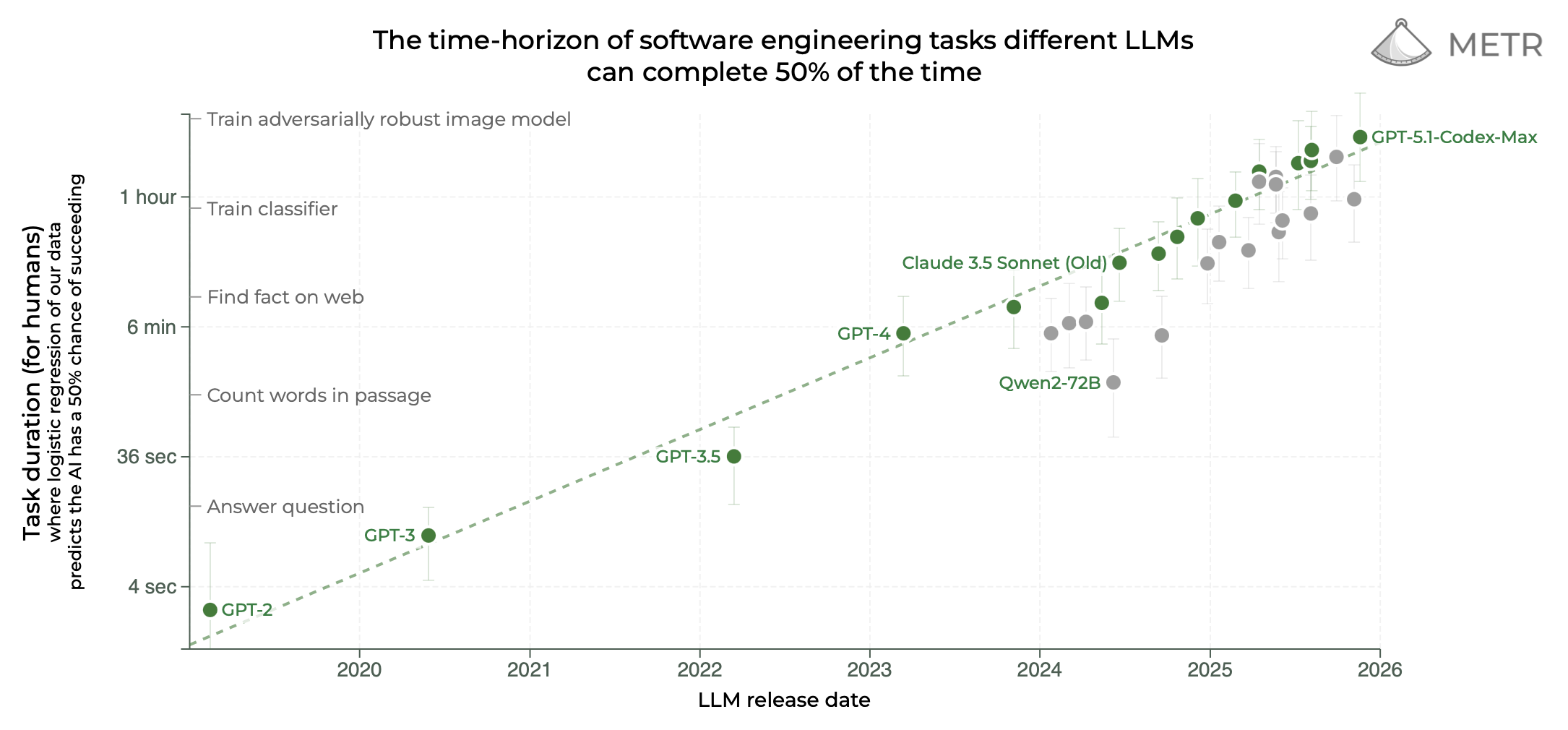
As this trend shows no signs of stopping, people have naturally taken to extrapolating it out, to forecast when we might expect AI to be able to do tasks that take an engineer a full work-day; or week; or year.
But we are missing a key piece of information — the cost of performing this work.
Over those 7 years AI systems have grown exponentially. The size of the models (parameter count) has grown by 4,000x and the number of times they are run in each task (tokens generated) has grown by about 100,000x. AI researchers have also found massive efficiencies, but it is eminently plausible that the cost for the peak performance measured by METR has been growing — and growing exponentially.
This might not be so bad. For example, if the best AI agents are able to complete tasks that are 3x longer each year and the costs to do so are also increasing by 3x each year, then the cost to have an AI agent perform tasks would remain the same multiple of what it costs a human to do those tasks. Or if the costs have a longer doubling time than the time-horizons, then the AI-systems would be getting cheaper compared with humans.
But what if the costs are growing more quickly than the time horizons? In that case, these cutting-edge AI systems would be getting less cost-competitive with humans over time. If so, the METR time-horizon trend could be misleading. It would be showing how the state of the art is improving, but part of this progress would be due to more and more lavish expenditure on compute so it would be diverging from what is economical. It would be becoming more like the Formula 1 of AI performance — showing what is possible, but not what is practical.
So in my view, a key question we need to ask is: ***How is the ‘hourly’ cost of AI agents changing over time?***
By ‘hourly’ cost I mean the financial cost of using an LLM to complete a task right at the model’s 50% time horizon divided by the length of that time horizon. So as with the METR time horizons themselves, the durations are measured not by how long it takes the model, but how long it typically takes humans to do that task. For example, Claude 4.1 Opus’s 50% time horizon is 2 hours: it can succeed in 50% of tasks that take human software engineers 2 hours. So we can look at how much it costs for it to perform such a task and divide by 2,
... (truncated, 14 KB total)Resource ID:
07564bcb27416824 | Stable ID: sid_aZNHDuD18a