2024 Edelman Trust Barometer
webCredibility Rating
Good quality. Reputable source with community review or editorial standards, but less rigorous than peer-reviewed venues.
Rating inherited from publication venue: Edelman
Relevant to AI governance discussions as a large-scale empirical measure of public trust in institutions managing transformative technologies like AI; useful for understanding the social legitimacy challenges facing AI deployment and regulation.
Metadata
Summary
The 2024 Edelman Trust Barometer surveyed global populations to reveal a paradox where rapid innovation—including AI—risks deepening societal distrust and political polarization rather than delivering prosperity. Key findings show that innovation acceptance is declining due to perceived political interference in science, weak institutional governance, and poor communication from scientific institutions. Business is marginally the most trusted institution to introduce innovations, but still falls below the threshold of full public trust.
Key Points
- •Nearly 2-to-1 respondents believe innovation is poorly managed due to insufficient regulation, distrust of leaders, and science's perceived political entanglement.
- •Business is most trusted (just below 60%) to introduce innovations safely; media is actively distrusted; income inequality amplifies trust gaps.
- •Peers are now as trusted as scientists for information on new innovations, signaling a communications crisis for scientific institutions.
- •Acceptance of AI and other breakthroughs depends on transparent implementation, ethical oversight, and demonstrated benefit to ordinary people.
- •Strong leadership and business-government partnerships are seen as essential to steering societies toward responsible innovation adoption.
Cited by 2 pages
| Page | Type | Quality |
|---|---|---|
| AI Epistemic Cruxes | Crux | 64.0 |
| AI-Driven Trust Decline | Risk | 55.0 |
Cached Content Preview
[Skip to main content](https://www.edelman.com/trust/2024/trust-barometer#main-content)

Innovation in Peril
[DOWNLOAD REPORT](https://edl.mn/3Rn6zO0 "Download Report")
[Scroll Down](https://www.edelman.com/trust/2024/trust-barometer#top "Scroll Down Page")
### Explore the 2026 Report
[LEARN MORE](https://www.edelman.com/trust/2026/trust-barometer)
## A collision of trust, innovation, and politics
The **2024 Edelman Trust Barometer** reveals a new paradox at the heart of society. Rapid innovation offers the promise of a new era of prosperity, but instead risks exacerbating trust issues, leading to further societal instability and political polarization.
In a year where half the global population can vote in new leaders, the acceptance of innovation is essential to the success of our society. While people agree that scientists are essential to the acceptance of innovation, many are concerned that politics has too much influence on science. This perception is contributing to the decline of trust in the institutions responsible for steering us through change and towards a more prosperous future.
**READ MORE**
**⇓**
## The decline of authority
Trust in companies from global powers is in decline, worry over societal threats and establishment leaders misleading us is growing, while peers are as trusted as scientists for information on new innovations.
## Innovation is on the ballot
Respondents see science as under political pressure, but feel government lacks the competence to regulate innovation effectively, so strong leadership is needed to move society towards acceptance.
## A reset for science in society
Science has a communications problem that can be improved with better messaging, more transparency, and an explanation of its impact on regular people.
## Restoring trust in the promise of innovation
Respondents are more likely to embrace an innovation if they are confident that it will lead to a better future.
### Explore the findings
[DOWNLOAD REPORT](https://edl.mn/3Rn6zO0 "Download Report")
## Business is trusted to make sure innovations are safe, understood & accessible
Most institutions are not trusted to introduce innovations to society. While business leads, it’s still just below 60 percent (Trust is 60 percent or above). Media is actively distrusted. And there is less trust across institutions among those with low income.

## Acceptance of innovation is at stake
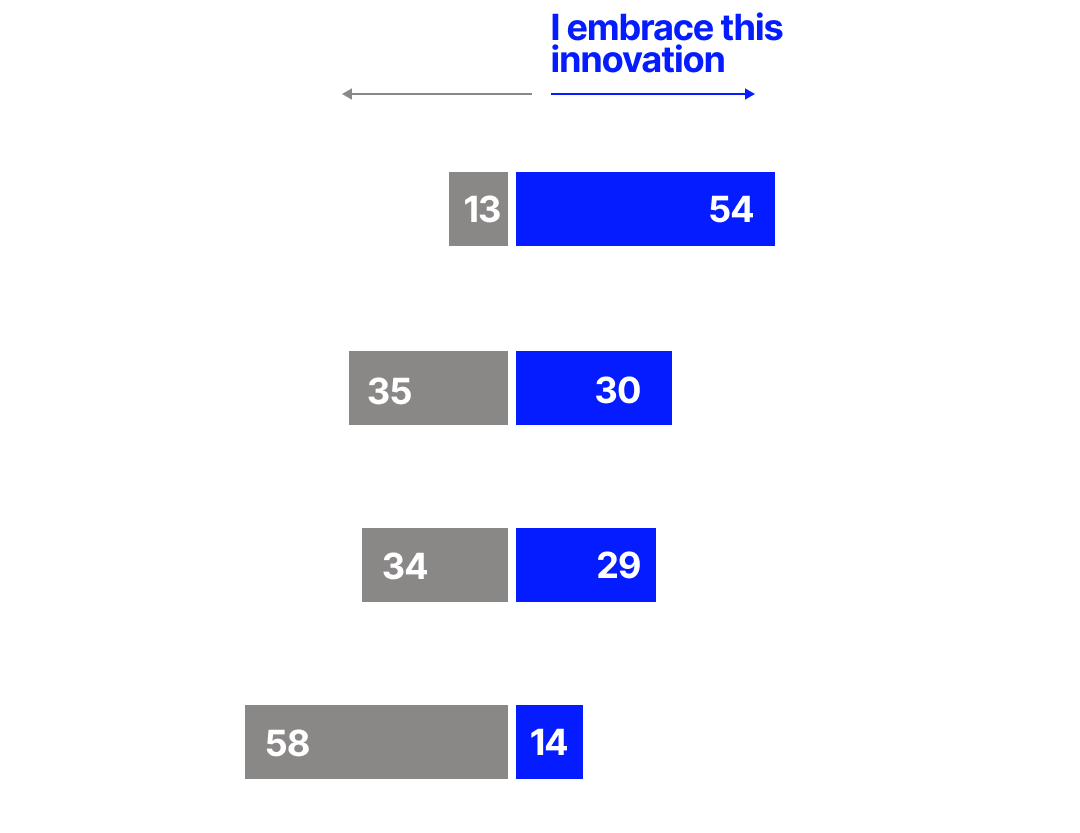
Respondents by nearly a two-to-one margin believe innovation is poorly managed (insufficient government regulation, lack of trust in traditional leaders, su
... (truncated, 12 KB total)1312df71e6a1ca40 | Stable ID: sid_jK8uMcuzT9