Orders of magnitude: use semitones, not decibels
webAuthor
Credibility Rating
Good quality. Reputable source with community review or editorial standards, but less rigorous than peer-reviewed venues.
Rating inherited from publication venue: LessWrong
A LessWrong post on quantitative reasoning and communication, tangentially relevant to AI safety insofar as clear thinking about orders of magnitude matters when discussing capability jumps or compute scaling.
Forum Post Details
Metadata
Summary
This LessWrong post argues that semitones (the musical interval unit) are a more intuitive and practical way to express multiplicative ratios and orders of magnitude than decibels. It presents semitones as a human-friendly logarithmic scale that makes reasoning about relative differences clearer, particularly when comparing quantities that span many orders of magnitude.
Key Points
- •Semitones represent a logarithmic scale (base 2^(1/12)) that humans find intuitive due to musical familiarity, making multiplicative comparisons easier.
- •Decibels, while also logarithmic, are less intuitive for general use because their base and reference points vary by context and field.
- •Using semitones for expressing ratios (e.g., AI capability differences, compute scaling) could improve clarity in quantitative reasoning discussions.
- •The post advocates for epistemic hygiene around how we express and communicate orders of magnitude in analytical contexts.
- •Adopting a consistent, intuitive unit for ratios can reduce cognitive errors when reasoning about large differences in scale.
Cached Content Preview
# Orders of magnitude: use semitones, not decibels
By Oliver Sourbut
Published: 2026-04-01
I'm going to teach you a secret. It's a secret known to few, a secret way of using parts of your brain _not meant for mathematics_... for mathematics. It's part of how I (sort of) do logarithms in my head. This is a nearly purposeless skill.
What's the growth rate? What's the doubling time? How many orders of magnitude bigger is it? How many years at this rate until it's quintupled?
All questions of ratios and scale.
Scale... hmm.
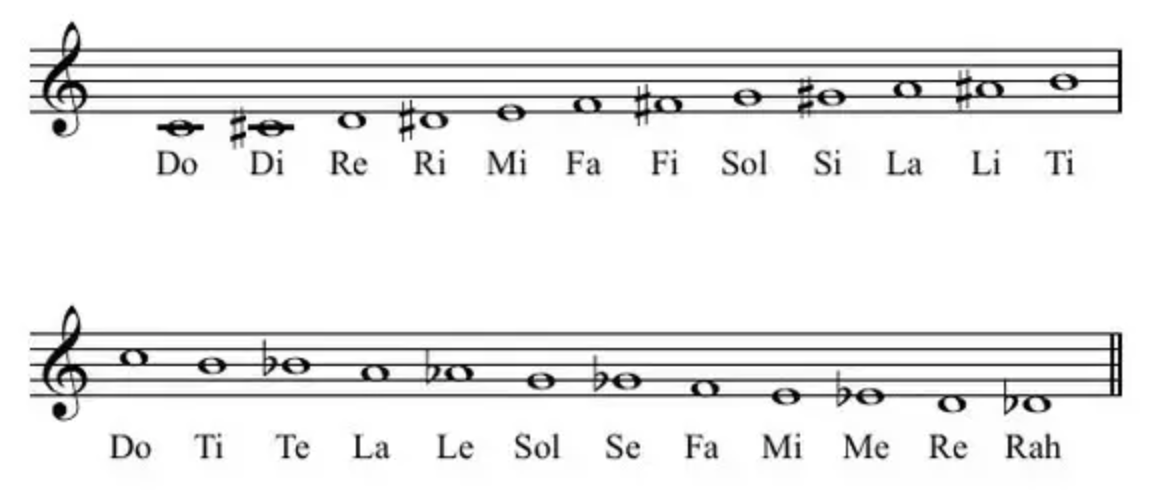
'Wait', you're thinking, 'let me check the date...'. Indeed. But please, stay with me for the logarithms.
## Musical intervals as ratios, and God's joke
If you're a music nerd like me, you'll know that an octave (abbreviated 8ve), the fundamental musical interval, represents a doubling of vibration frequency. So if [A440](https://en.wikipedia.org/wiki/A440_(pitch_standard)) is at 440Hz, then 220Hz and 880Hz are also 'A'. Our ears tend to hear this as 'the same note, only higher'.
That means the 'same' interval, an octave, corresponds to successively greater gaps in frequency. First a doubling, then a quadrupling, an octupling, and so on. Our perception, and musical notation, maps the space of frequencies logarithmically.
You'll also know that a '[perfect fifth](https://en.wikipedia.org/wiki/Perfect_fifth)' is a ratio of $3:2$. A to the E above it, C# to the G# above it, etc. Consonance is _all about nice ratios_! (Ask [Pythagoras](https://en.wikipedia.org/wiki/Pythagorean_tuning).)
At least, the really sweet, in tune fifths are this ratio. Because God is an absolute wheeze, you can keep moving in fifths ($3:2$) and octaves and get 'new notes' eleven times. That's where we get our Western scale from, originally (except it's _originally_ originally Mesopotamian probably). The twelfth time ($(3:2)^{12}$) gets you to a ratio of roughly $129.7:1$. That's _almost exactly_ seven doublings, seven octaves (7 * 8ve)! That'd be $128:1$. God's joke is in [that roughly 1% margin](https://youtu.be/1DUZsQ2by2s?si=4fGwAq6dub-eyV2T&t=96), and musicians have been arguing about what to do about it for centuries. [It's a whole thing](https://en.wikipedia.org/wiki/Musical_temperament).[^equal]
[^equal]: [Usually nowadays](https://en.wikipedia.org/wiki/Equal_temperament) we squish all the fifths a tiny bit so that when stacked up they get to that delicious 128:1.
Cutting a long story short, that leaves us with twelve different notes dividing up the octave. They 'repeat', with 'the same' note again and again at either higher or lower octaves (a full doubling of frequency).
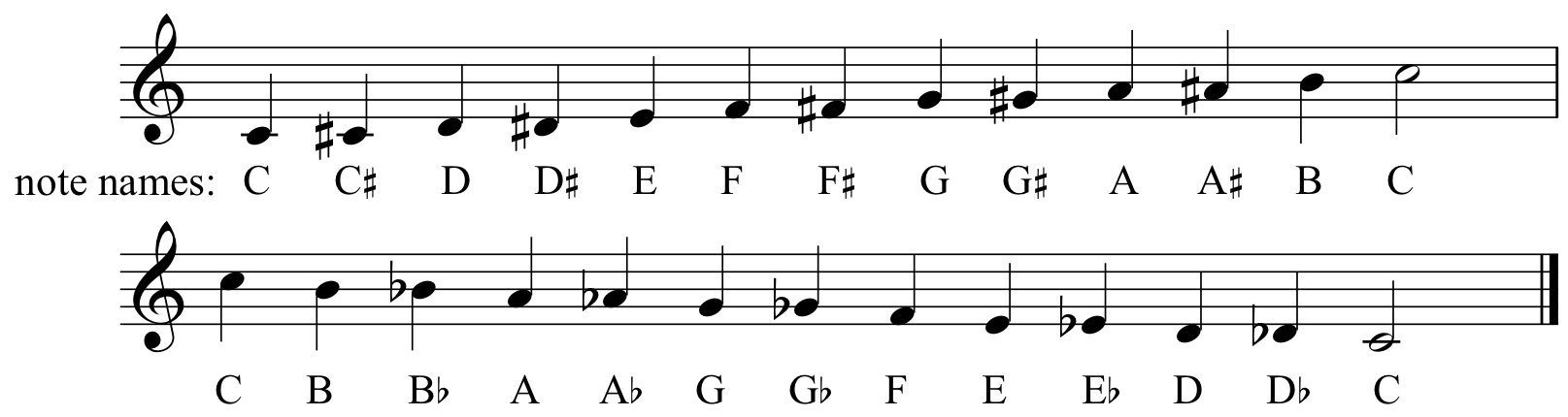
In between octaves, those twelve divisions need to 'add up to' a doubling. For reasons, two steps (a sixth of the overall scale) is referred to as a 'tone', and a single step (a twelfth of the scale) is thus a 'semitone'. That means each
... (truncated, 9 KB total)30cdd842505dc6c0 | Stable ID: sid_yFFHyNRFIR