Two Skillsets You Need to Launch an Impactful AI Safety Project
webAuthors
Luc Brinkman·plex
Credibility Rating
3/5
Good(3)Good quality. Reputable source with community review or editorial standards, but less rigorous than peer-reviewed venues.
Rating inherited from publication venue: LessWrong
A practical LessWrong post offering career and project guidance for AI safety practitioners, emphasizing that both technical expertise and organizational execution skills are needed to make meaningful contributions.
Forum Post Details
Karma
56
Comments
0
Forum
lesswrong
Forum Tags
AI
Metadata
Importance: 38/100educational
Summary
This LessWrong post outlines two core skillsets required to successfully launch an impactful AI safety project: technical/research competence and project/organizational execution skills. It argues that both are necessary and that neglecting either leads to projects that either lack rigor or fail to gain traction and real-world impact.
Key Points
- •Effective AI safety projects require both deep technical or research skills and strong execution/organizational capabilities.
- •Many well-intentioned safety projects fail not from lack of ideas but from insufficient ability to plan, coordinate, and deliver.
- •The post encourages aspiring AI safety contributors to honestly assess and develop whichever skillset they are currently lacking.
- •Combining research insight with practical project management increases the likelihood that safety work reaches meaningful scale and influence.
- •The framing is intended as actionable career and project advice for those entering or growing within the AI safety field.
Cached Content Preview
HTTP 200Fetched Apr 7, 202616 KB
# Two Skillsets You Need to Launch an Impactful AI Safety Project
By Luc Brinkman, plex
Published: 2026-03-18
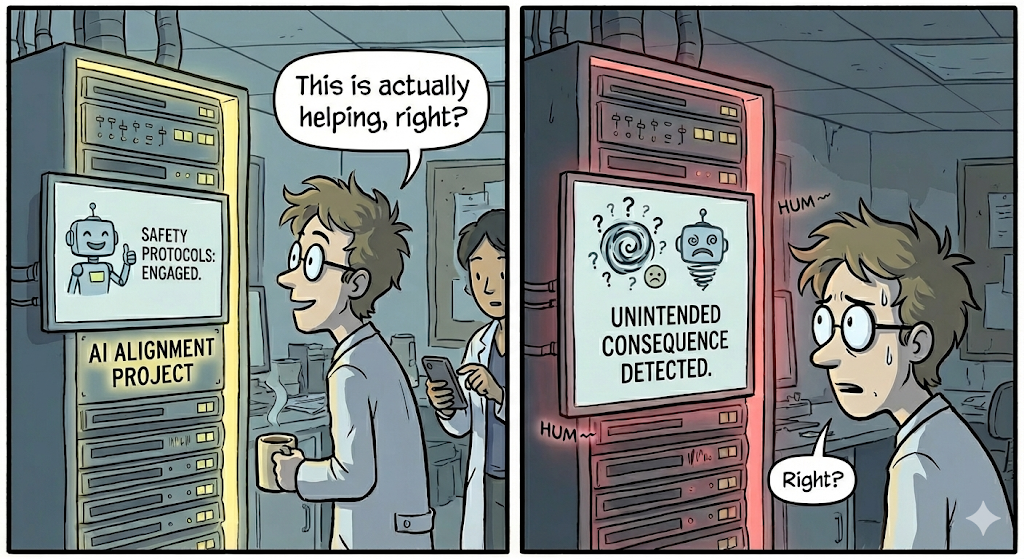
Your project might be failing without you even knowing it.
It’s hard to save the world. If you’re launching a new AI Safety project, this sequence helps you avoid common pitfalls.
Your most likely failure modes along the way:
**You never get started.** Entrepreneurship is uncomfortable, and AI Safety is complex. There are many failure modes. It’s hard to figure out how to do something useful, so many people never try. Simultaneously, many things in AI Safety that obviously should be done are not done yet. You might mistakenly assume they’re already being done and therefore not try them.
**You move slowly, fail to gain traction, and get stuck.** You launch a tool – six months later, you have 12 users. You keep adding features, hoping something will change. Nothing does.
**You satisfice.** You figure that what you’re doing must be high impact, just because it’s part of AI Safety. In reality, you could be having 10x more impact than you are.
**You fail without realizing it.** You have users, citations, participants. But you're not actually reducing x-risk, and you don't realize it because you're not tracking your impact or not tracking the right things.
To set yourself up for success, you need two broad skillsets: entrepreneurial skills and impact-specific skills, which include impact estimation and strategic understanding of AI Safety. Mastering both skillsets is rare – we for sure know we haven’t.[^-kjsWFw9DpX9KFBxEG-1]
Impact = Adoption × Effectiveness
=================================
To have impact, you need to:
* Build something (execution)
* That people engage with (adoption)
* In ways that create impact (effectiveness)[^-kjsWFw9DpX9KFBxEG-3]
Think of it roughly as: **Impact = Adoption × Effectiveness**[^-kjsWFw9DpX9KFBxEG-2]
You'll require competent execution to build *anything* at all. But that's not enough. You need to find *the right thing* to build. Something that leads to positive impact.
The Two Impact Multipliers
==========================
These two skillsets help you create something impactful:
**1\. Entrepreneurial skills** help you iterate toward something people actually engage with.
**2\. Impact skills** guide you to the effectiveness that translates adoption into impact. This is tricky because you can’t directly measure whether you reduced AI x-risk until it’s too late to act on that information. Nevertheless, we’ll introduce the skills that will help you increase your odds.
Together, these help you understand the problems in AI Safety, prioritize between them, and develop solutions that work.
Most Projects Won’t Matter. Yours Could.
========================================
Your work isn’t automatically high-impact just because it’s part of AI Safety.
Impact follows s
... (truncated, 16 KB total)Resource ID:
315415dcd97572c6 | Stable ID: sid_fH4iyCuH8o