Aquaculture fragmentation is a portfolio problem CEAs miss
webAuthor
Credibility Rating
Good quality. Reputable source with community review or editorial standards, but less rigorous than peer-reviewed venues.
Rating inherited from publication venue: EA Forum
This EA Forum post is relevant to cause prioritization methodology and portfolio thinking in effective altruism; it critiques standard CEA tools in a non-AI domain but has broader implications for how fragmented funding landscapes are evaluated.
Forum Post Details
Metadata
Summary
This post argues that cost-effectiveness analyses (CEAs) for aquaculture animal welfare interventions systematically fail to account for portfolio-level fragmentation effects, where funding is spread across many small, disconnected projects. It suggests this structural problem leads to misallocation of resources in the effective altruism space focused on farmed fish and other aquatic animals.
Key Points
- •CEAs for aquaculture welfare interventions typically evaluate projects in isolation, missing systemic fragmentation across the portfolio of funded efforts.
- •Fragmentation across many small aquaculture projects reduces collective impact compared to more coordinated or concentrated funding strategies.
- •Standard EA cost-effectiveness frameworks are ill-suited to capture coordination failures and portfolio-level inefficiencies in animal welfare funding.
- •The post calls for revised evaluation methodologies that account for how interventions interact at a portfolio level rather than just individual project ROI.
- •Aquaculture represents a large-scale neglected cause area where analytical blind spots in CEAs may be causing significant opportunity cost.
Cached Content Preview
# Aquaculture fragmentation is a portfolio problem CEAs miss
By Chiawen_Chiang
Published: 2026-03-03
**TLDR:** Welfare interventions in aquaculture don't reliably transfer across species, so each species requires independent research and implementation. I introduce "target populations" as a unit of analysis to quantify how many groups exist. From 2000 to 2023, the number of species comprising 85% of aquaculture production grew from 14 to 22. This means the structural cost of covering the same share of the industry has grown substantially, independent of how well any single intervention performs. This is a portfolio problem, not an intervention problem, and many major producing countries are trending towards further fragmentation.
Summary
=======
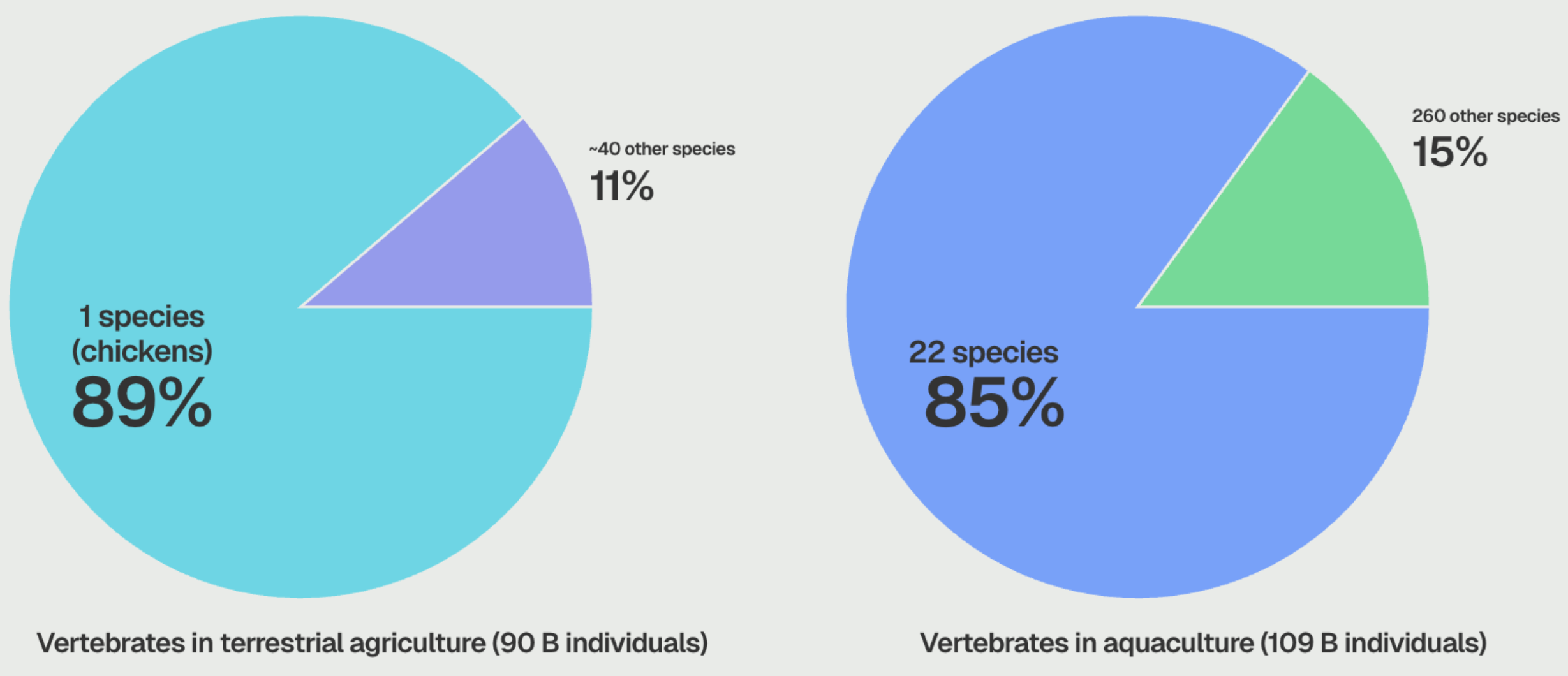
In terrestrial agriculture, one species (the domestic chicken) accounts for [89%](https://animalcharityevaluators.org/wp-content/uploads/2024/09/The-Most-Numerous-Animal-Groups-and-Species.pdf) of all farmed vertebrates. That lack of species diversity is part of what made cage-free campaigns scalable and tractable: the same welfare issues recurred across farms, enabling one intervention to address the same problem everywhere, and similar farm contexts made that intervention feasible everywhere.
Aquaculture does not have this structure. 22 species (e.g. Mrigal carp, Atlantic salmon) comprise 85% of farmed aquatic vertebrates, and 260 more account for the rest. This diversity has not consolidated over time. The number of species comprising the top 85% of production has increased from 14 to 22 since 2000.
This matters because welfare interventions don't easily transfer across species. Even if some welfare problems fundamentally are shared (e.g. low oxygen is bad), in practice their biology and farming practices can be so different that an intervention developed for a shared problem in one species won’t work as effectively for others. Surface paddle aerators that improve oxygen for carp are useless for Atlantic salmon because they live deeper in the water column. Percussive stunners, even if validated for Atlantic salmon, will never work for tilapia because their skulls are too laterally compressed. The further apart two species are taxonomically, the less likely interventions carry over. At the distance between salmon and tilapia, about as far taxonomically as a chicken and a crocodile, we should assume that no intervention transfers, even if basic biological principles are conserved.
Most cost-effectiveness analyses (CEAs) look at one intervention in isolation, or compare one intervention against another. That level of analysis is useful, but it cannot see the landscape as a whole. As the industry fragments across more species, covering the same *share* of the industry requires more distinct interventions. This is a structural overhead cost that grows with fragmentation regardless of how
... (truncated, 28 KB total)36e01d0587db232a | Stable ID: sid_zCemmFPLPC