MATS Alumni Impact Analysis - EA Forum
blogAuthor
Credibility Rating
Good quality. Reputable source with community review or editorial standards, but less rigorous than peer-reviewed venues.
Rating inherited from publication venue: EA Forum
This retrospective survey-based impact report is useful for evaluating AI safety talent pipeline programs and informing decisions about fellowship and training investments within the EA and AI safety communities.
Forum Post Details
Metadata
Summary
An impact evaluation of 72 alumni from the first four MATS (Machine Learning for Alignment Taskforce) cohorts (2021-2023), finding that 78% work on AI alignment research, 68% published alignment research, and 63% found research collaborators through the program. The report demonstrates MATS's effectiveness as a pipeline for building AI safety research careers and career capital.
Key Points
- •78% of surveyed alumni work on or conduct AI alignment research, with 49% in formal alignment roles and 29% conducting independent research.
- •68% of alumni published alignment research, with 78% attributing their publication at least partly to MATS participation.
- •54% of alumni advanced past first-round interviews for jobs after MATS, with program-built career capital cited as a key factor.
- •63% of scholars met research collaborators through MATS, highlighting the program's networking and community-building value.
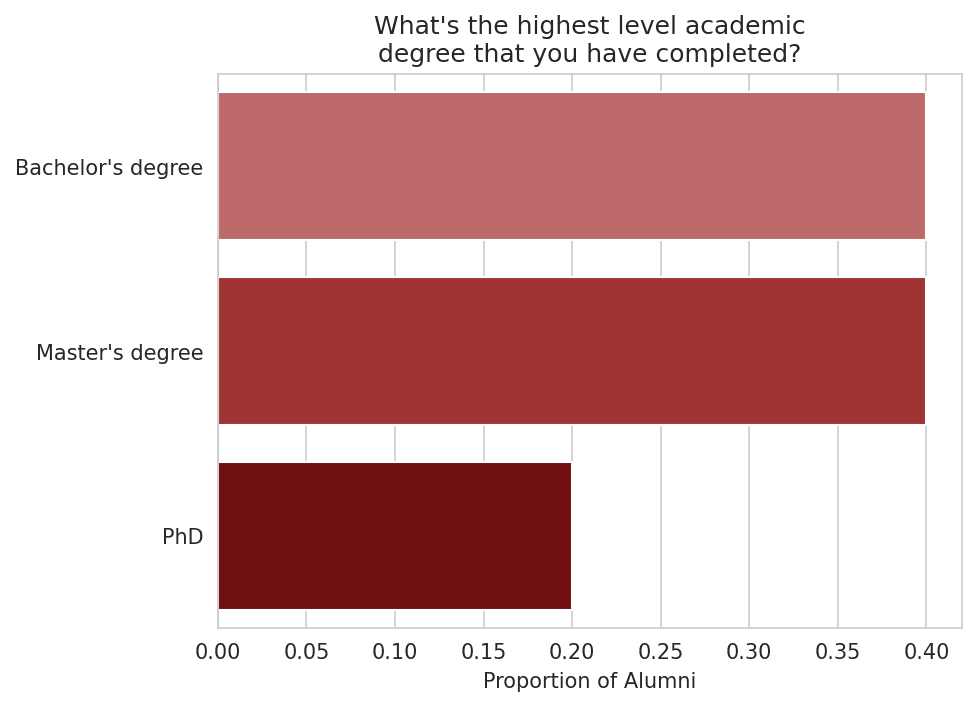
- •Alumni cohort was educationally diverse: 40% held Bachelor's degrees, 40% Master's, and 20% PhDs at time of participation.
Cited by 1 page
| Page | Type | Quality |
|---|---|---|
| MATS ML Alignment Theory Scholars program | Organization | 60.0 |
Cached Content Preview
# MATS Alumni Impact Analysis
By utilistrutil
Published: 2024-10-02
Summary
=======
This winter, [MATS](https://www.matsprogram.org/) will be running our seventh program. In early-mid 2024, 46% of alumni from our first four programs (Winter 2021-22 to Summer 2023) completed a survey about their career progress since participating in MATS. This report presents key findings from the responses of these 72 alumni.
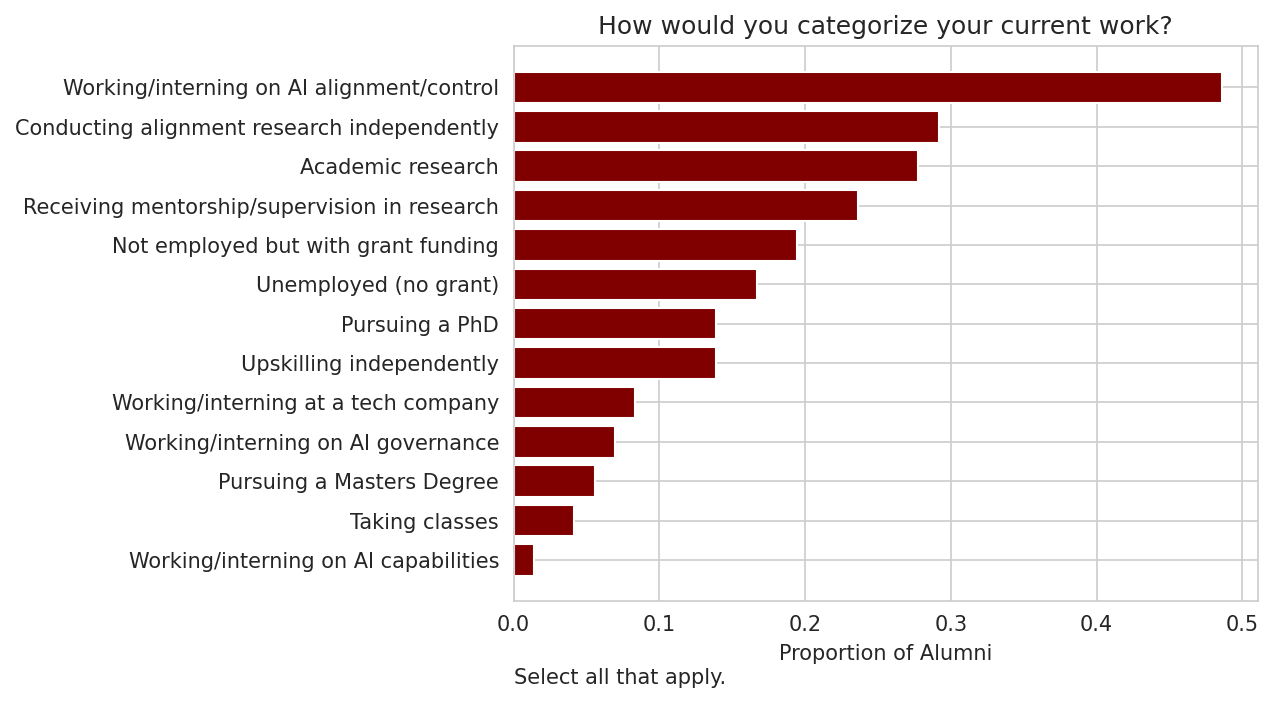
* 78% of respondents described their current work as "Working/interning on AI alignment/control" or "Conducting alignment research independently."
* 49% are "Working/interning on AI alignment/control."
* 29% are "Conducting alignment research independently."
* 1.4% are "Working/interning on AI capabilities."
* Since MATS, 54% of respondents applied to a job and advanced past the first round of interviews.
* 64% of those who shared more details accepted a job offer.
* Alumni reported that MATS made it more likely that they applied to these jobs by helping them build legible career capital and develop research/technical skills.
* During or since MATS, 68% of alumni had published alignment research.
* The most common type of publication was a LessWrong post (45%).
* 78% of respondents said their publication “possibly” or “probably” would not have happened without MATS.
* 10% of alumni reported that MATS accelerated publication by more than 6 months; 14% said 1-6 months.
* 8% of alumni responded that MATS resulted in a “much higher” quality of their publication.
* 63% of scholars met a research collaborator through MATS
* At this stage in their careers, 46% of alumni would benefit from more connections to research collaborators, and 39% would benefit from job recommendations.
Background on Cohort
====================
For 40% of respondents, their highest academic degree was a Bachelor’s; 40% had earned at most a Master’s, and 20%, a PhD.
Their most common categories of current work were “Working/interning on AI alignment/control” (49%) and “Conducting alignment research independently” (29%).
Here are some representative descriptions of the work alumni were doing:
* “Going through the first year of grad school at Oxford and continuing research that emerged from my time at MATS.”
* “Working on an interpretability project at AI Safety Camp and just finished the s-risk intro fellowship by CLR a week or two ago.”
* “What could be called "prosaic agent foundations" with the AF team @ MIRI”
* “Co-founding for-profit AI safety company with a product”
* “I'm back at my PhD at Imperial, taking an idea I developed during MATS 3.1 and trying to turn it into a PhD project.”
* “I'm working as a post doc in academia on
... (truncated, 24 KB total)5ec1ccf96a75f10c | Stable ID: sid_99ONqW2cSg