CFAR Financial Overview
webCredibility Rating
Good quality. Reputable source with community review or editorial standards, but less rigorous than peer-reviewed venues.
Rating inherited from publication venue: Center for Applied Rationality
CFAR (Center for Applied Rationality) trains reasoning skills for researchers including those in AI safety; this financial overview is primarily relevant for those evaluating CFAR as a funding recipient or studying nonprofit operations in the AI safety ecosystem.
Metadata
Summary
A financial transparency report from the Center for Applied Rationality (CFAR) for 2019, detailing the organization's revenue, expenses, and financial health. CFAR is a nonprofit focused on developing and teaching rationality skills, with indirect relevance to AI safety through its work training researchers and community members.
Key Points
- •Provides a breakdown of CFAR's income sources, including donations and program revenue from workshops
- •Details organizational expenses including staff, programs, and operational costs
- •Demonstrates financial transparency practices for an AI safety-adjacent nonprofit
- •CFAR's work is relevant to AI safety by training rationality skills in the EA and AI safety communities
Cited by 1 page
| Page | Type | Quality |
|---|---|---|
| Center for Applied Rationality | Organization | 62.0 |
Cached Content Preview
_Note: This document is intended as an informal, easily-readable overview of CFAR’s income and expenses in 2018 and 2019, and of our financial projections for 2020. You can view our 2019 Independent Auditor’s Report [here](https://www.rationality.org/files/CFAR%20-%20Independent%20Auditor's%20Report%20for%202019.pdf), and our most recent 990 [here](https://www.rationality.org/files/cfar-2018-990.pdf)._
## 2018 Income
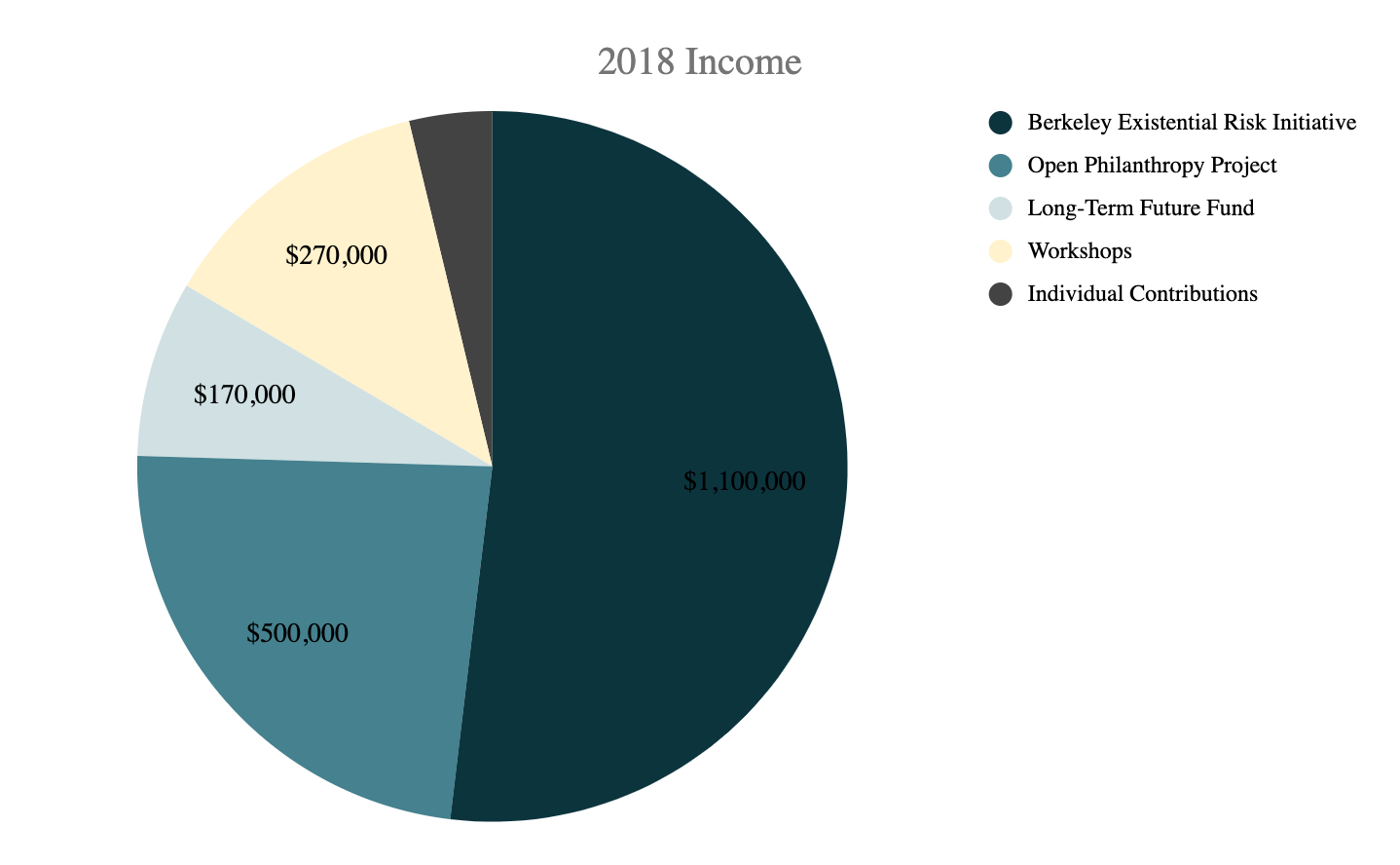
In 2018, CFAR[1](https://www.rationality.org/resources/updates/2019/cfar-financial-overview#fn:1) received approximately $2.2 million in revenue. Half this sum came in the form of general support from BERI (the Berkeley Existential Risk Initiative), $800k of which was granted to fund the down payment on our purchase of a permanent venue in Bodega Bay. The remainder was a mix of grants from Open Philanthropy Project and Long-Term Future Fund, individual contributions, and workshop revenue.
## 2018 Expenses
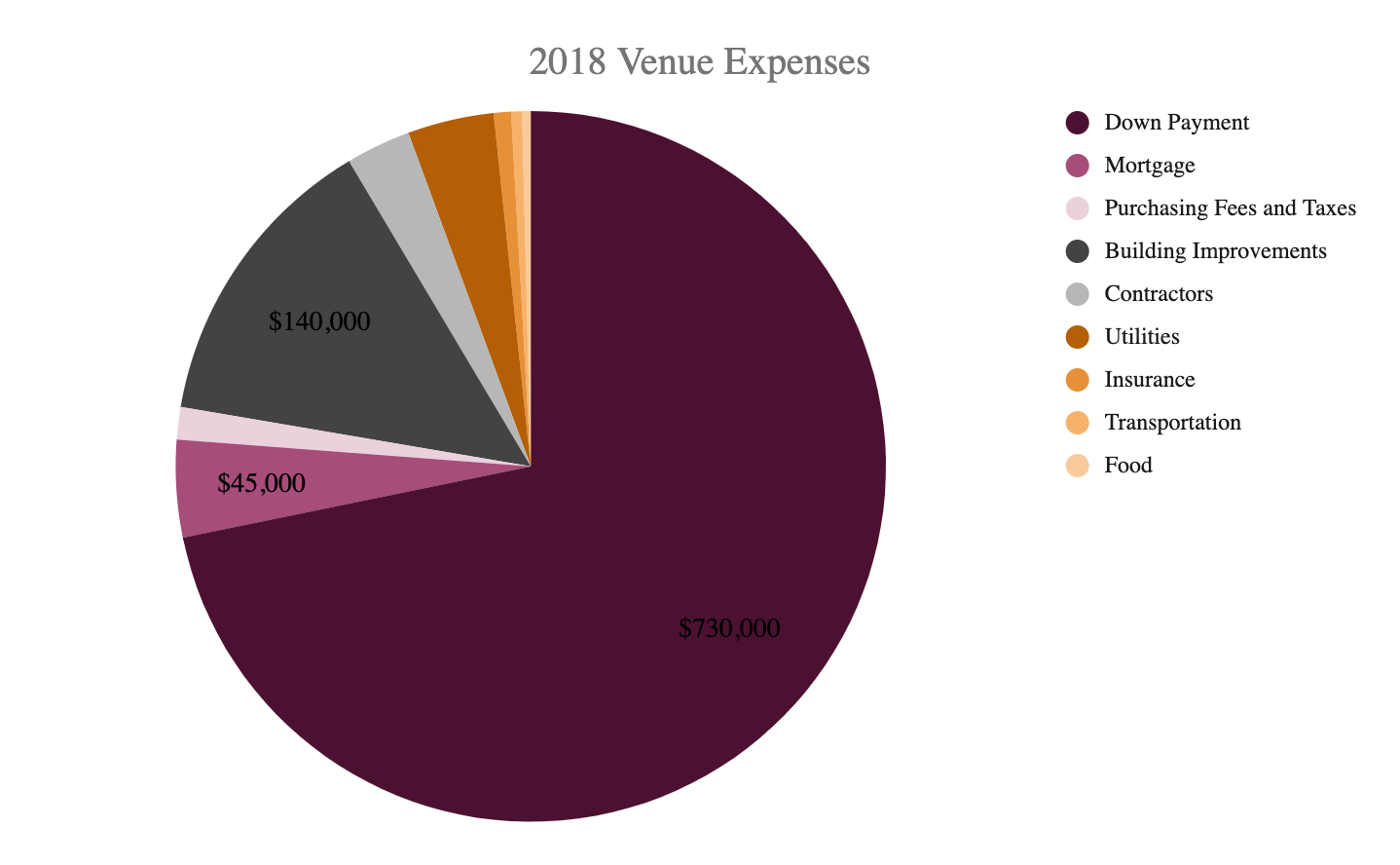
In 2018, CFAR spent approximately $2.6 million. ~40% of this sum went toward the purchase and renovation of our venue in Bodega Bay, ~25% went to salaries, and the rest went toward programs and operating expenses.
Note that the figures for “programs” below (i.e. for mainlines, AI safety workshops, etc.) only include expenses we wouldn’t otherwise have incurred had we not run that workshop on the margin—e.g., they don’t include recurring, mostly-independent costs like staff salaries and venue maintenance.
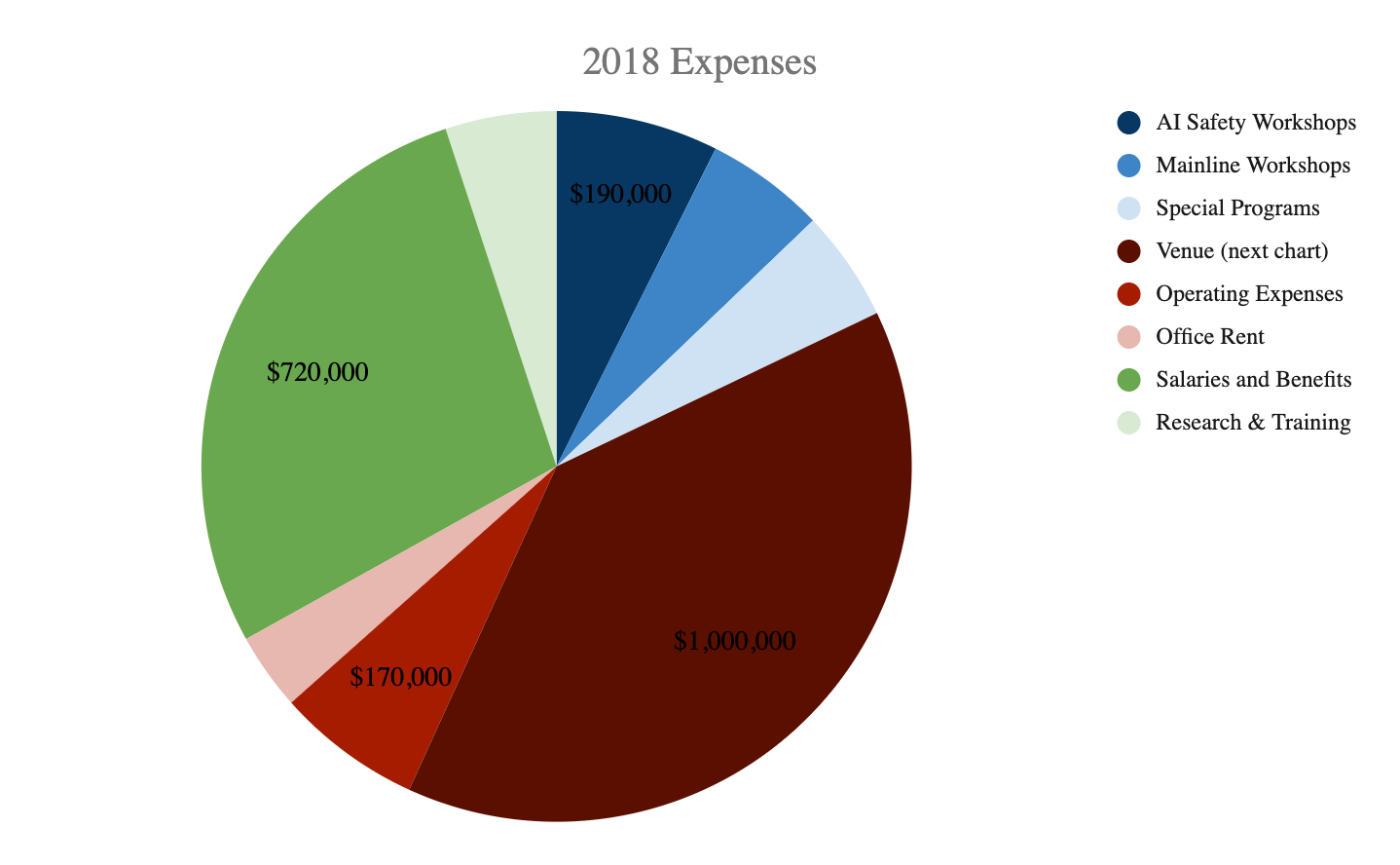
Since we bought and renovated our permanent venue in 2018, venue-related expenses composed a large portion of our budget that year. You can see this category broken down here:
## 2019 Income
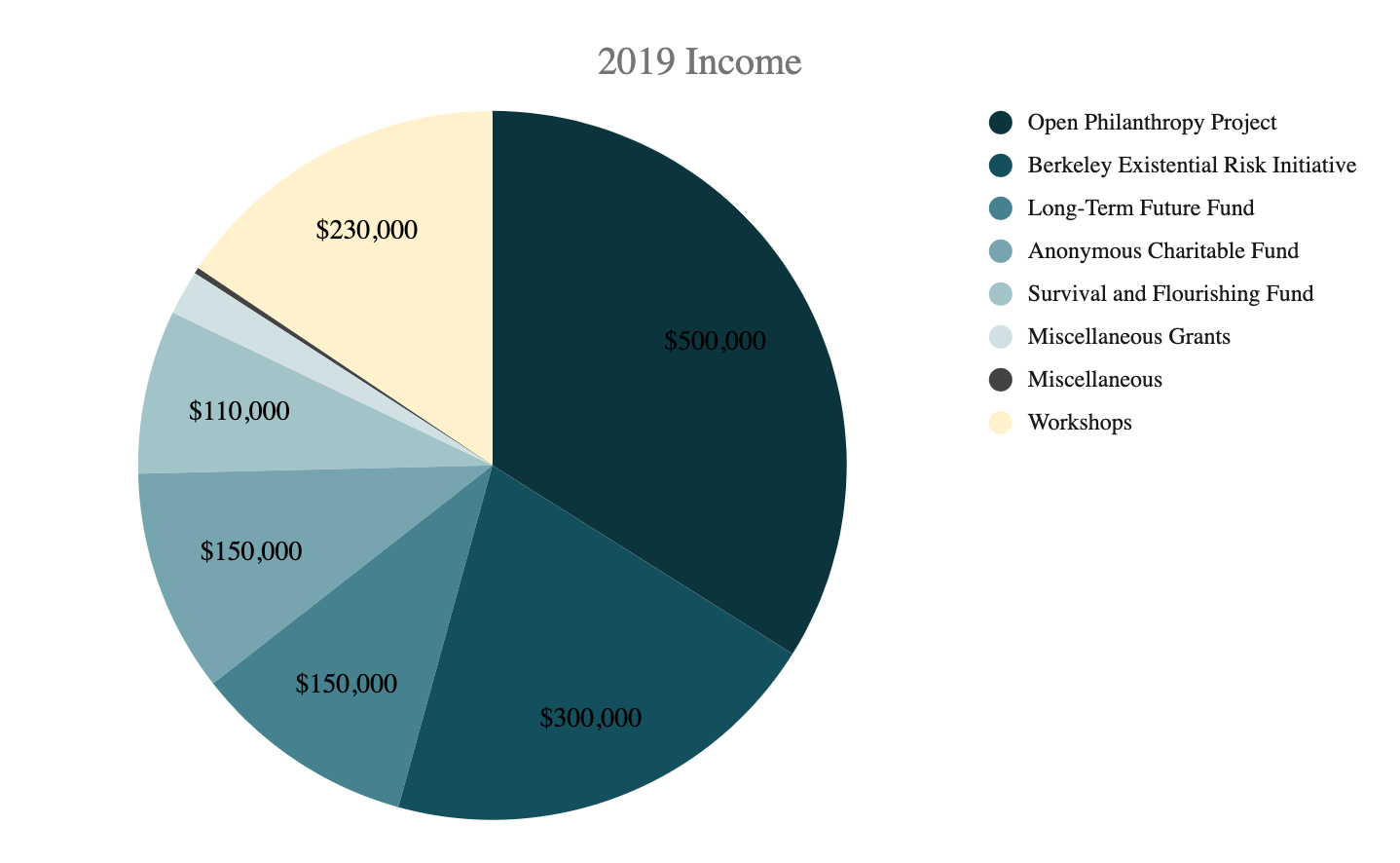
As of December 1, CFAR had received approximately $1.5 million in 2019. 84% of this sum came from grants (mostly from Open Phil, BERI, LTFF[2](https://www.rationality.org/resources/updates/2019/cfar-financial-overview#fn:2), SFF, and an anonymous charitable fund), and 16% came from workshop revenue.
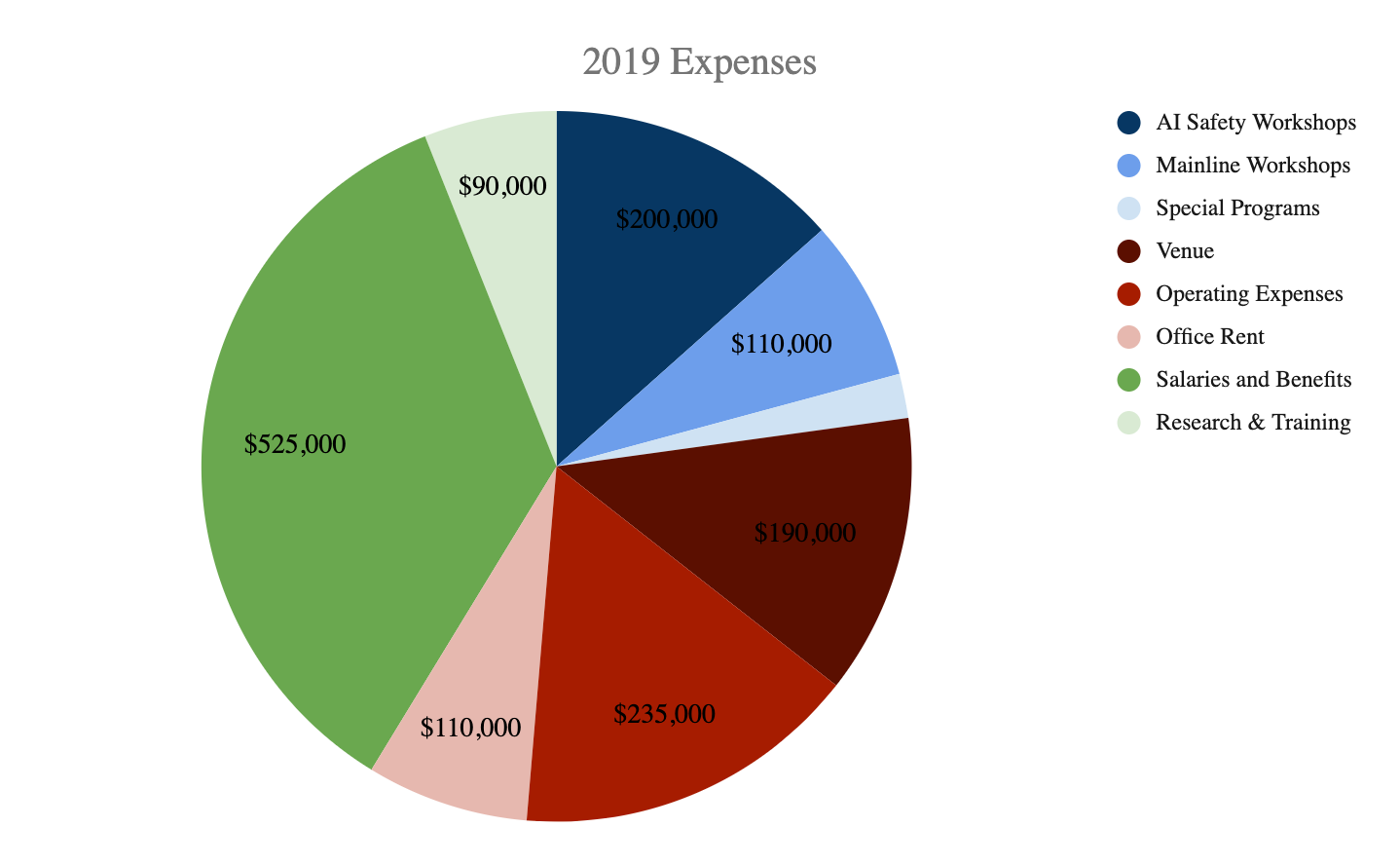
## 2019 Expenses
As of November 1, CFAR had spent approximately $1.4 million.
## 2020 Outlook
As of December 1, CFAR has about $1.4 million—$650,000 of cash, $575,000 of expected grants, and roughly $215,000 of accounts receivable (expected reimbursements from MIRI for AIRCS and MSFP).
In 2020, we expect to spend approximately $115,000 per month, although that fluctuates as (among other things) a function of our staff size and workshop output rate. Assuming our expenses and workshop revenue in 2020 are similar to those in 2019, CFAR currently has about 12 months of runway; in general, we aim to operate at about 18 months of runway.
We’re planning
... (truncated, 4 KB total)b064c8cb893edb37 | Stable ID: sid_mkwonnM4ay